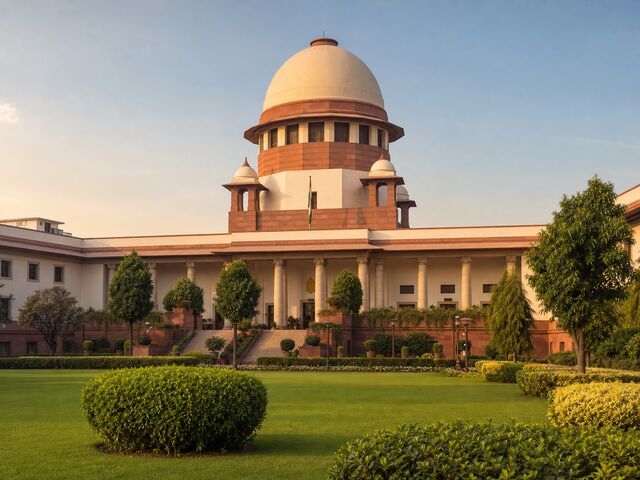
Public law matters move quickly and are decided on principle. We prepare them accordingly: a tight statement of the question the court must answer, the strongest authorities, and a clear case for the relief sought, including interim relief where the facts justify it.
Much of this work turns on threshold questions before the merits are reached: whether the petitioner has standing, whether there is an alternative remedy, whether there has been delay, and whether the respondent is amenable to the court’s writ jurisdiction. We address these early and honestly.
We act for individuals, businesses and institutions, and advise on policy and regulatory questions before they reach court.
Forums
Other areas
Writ petitions
Petitions under Article 226 before the High Court and Article 32 before the Supreme Court, seeking writs of certiorari, mandamus, prohibition, habeas corpus and quo warranto, or directions for the enforcement of fundamental and legal rights.
Challenges to legislation and executive action
Challenges to statutes, rules, notifications and orders on grounds including violation of Articles 14, 19 and 21, lack of legislative competence, arbitrariness and excessive delegation.
Interim relief
Applications for stay, status quo and other urgent protection, framed narrowly and supported by evidence of concrete harm.
Public interest litigation
Advice on whether a matter is suited to public interest litigation, and on presenting it in a way that serves the public interest rather than a private grievance.
Service and administrative law
Service matters, disciplinary proceedings and challenges to administrative decisions, including proceedings before the Kerala Administrative Tribunal and review by the High Court.
Tribunals and statutory appeals
Appeals and petitions arising from the decisions of tribunals and regulators, and special leave petitions before the Supreme Court under Article 136.
- 01
Frame the question
We identify the precise provision or order in issue and the legal question the court must answer.
- 02
Test maintainability
We assess standing, delay, alternative remedies and the respondent’s amenability to writ jurisdiction, and advise candidly on the prospects.
- 03
File and mention
We prepare the petition and supporting documents and, where the facts justify it, seek urgent listing and interim relief.
- 04
Hearing and appeal
We argue the matter and advise on any intra-court appeal or further challenge.
Frequently asked questions.
General information only. Your circumstances may differ, and this is not legal advice.
Can I approach the High Court directly?
Often yes, under Article 226. However, the court may decline to entertain a petition where an effective alternative remedy exists. Exceptions are recognised, for example where fundamental rights are violated, where natural justice has been breached, or where the vires of a law is challenged.
Does delay affect a writ petition?
Yes. There is no fixed limitation period for a writ petition, but unexplained delay can lead the court to refuse relief. Move promptly.
Can a writ be issued against a private party?
Writs generally lie against the State and its instrumentalities. In limited circumstances, they may reach a private body that performs a public function. Whether that applies depends on the facts.